
Policy & News
World's 2nd RSV vaccine approved for marketing by FDA
2023-06-05
On 31 May, Pfizer announced that its bivalent respiratory syncytial virus (RSV) vaccine, ABRYSVO (RSVpreF, PF-06928316), has been approved for marketing by the FDA for the prevention of lower respiratory tract disease (LRTD) caused by RSV in people 60 years of age and older, making it the second RSV vaccine approved for marketing in the world.
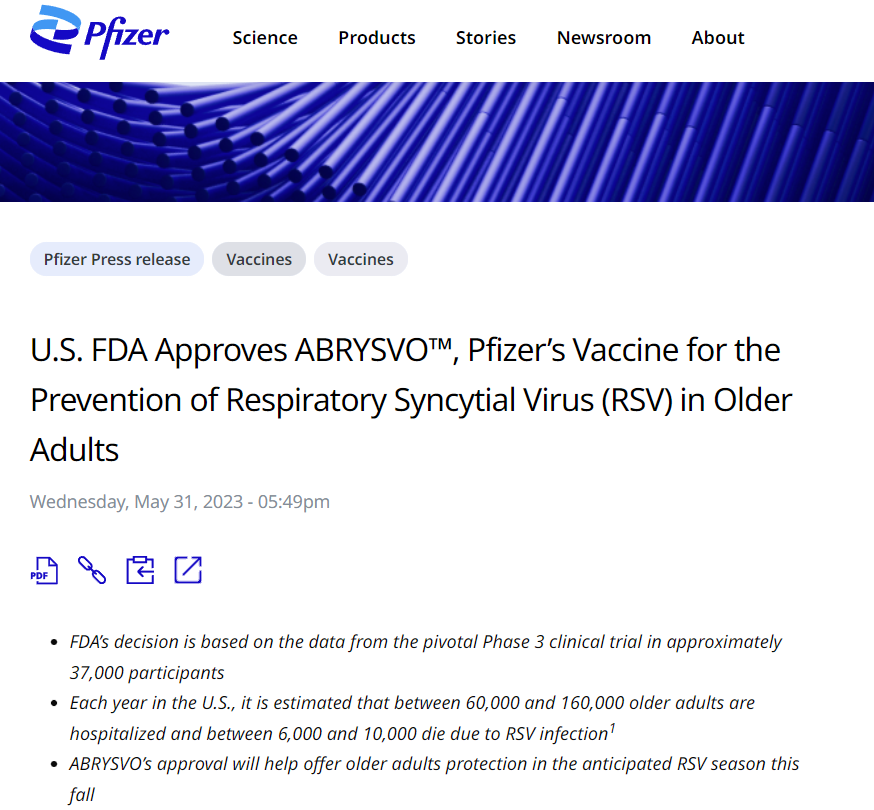
The approval is based on pivotal data from RENOIR (NCT05035212), a Phase III trial for the prevention of RSV infection in people aged 60 years and older, which enrolled approximately 37,000 subjects randomised 1:1 to receive either PF-06928316 or placebo, and which demonstrated a 66.7% effectiveness (RSV-related lower respiratory tract disease, defined as at least 2 symptoms) for severe disease (defined as at least 3 symptoms) and an 85.7% effectiveness for severe disease (defined as at least 3 symptoms). The results showed that PF-06928316 was 66.7% effective (RSV-associated lower respiratory tract disease, defined as at least 2 symptoms) and 85.7% effective for severe disease (defined as at least 3 symptoms). In addition, the vaccine was well tolerated and safe.
It is also worth noting that PF-06928316, a BLA for the prevention of RSV-associated lower respiratory tract disease in infants from birth to 6 months of age through active immunisation of pregnant women, was accepted by the FDA in February this year, with a PDUFA scheduled for August this year.
Last month, GlaxoSmithKline's RSV vaccine, Arexvy, was approved by the FDA for marketing in the elderly population for the prevention of respiratory syncytial virus (RSV) infection leading to lower-whistling tract disease (RSV-LRTD), making it the world's first RSV vaccine to be approved.
In addition, in November last year, Beyfortus (nirsevimab), jointly developed by AstraZeneca and Sanofi, was approved for marketing by the European Commission, making it the world's first and only RSV prophylaxis that can be widely used in newborns and infants, including healthy infants born at term or preterm, or infants with special health conditions.
RSV belongs to the genus Pneumovirus in the family Paramyxoviridae, and is a common seasonal infectious virus that causes respiratory tract infections, and the elderly and infants are susceptible to RSV. Statistics show that in the U.S. alone, RSV hospitalises approximately 177,000 people in adults aged 65 years and older each year and causes approximately 14,000 deaths. RSV has become a recognised global health problem, bringing a huge disease burden to the world. The prevention of RSV infection has been ranked as one of the top global priorities by WHO, and the research and development of RSV prevention products has also been ranked as one of the highest global priorities by WHO.
Up to now, in addition to the approved products, there are a number of domestic and foreign pharmaceutical companies in the field of RSV therapy layout, of which, the more forward including Moderna's mRNA-1345 vaccine, is expected to be declared on the market in the first half of this year, and the research data show that the effectiveness of this product in preventing the protection of RSV infection in the elderly population is 83.7%. As for domestic companies, a number of them, including Aike Bafa, Ai Diwei Xin, Zhifei Bio, Watson Bio/Blue Magpie Bio, and Shiyi Pharmaceutical Group, are promoting RSV-related therapies. In October last year, Akebia had reported positive results from the Phase III clinical trial (AIRFLO) of its RSV inhibitor, Acevir (AK0529), in the treatment of hospitalised infants and children infected with RSV at the 12th Annual International Conference on Respiratory Syncytial Virus (AIRSV). Compared to placebo, ezetimibe met the primary endpoint of a significant reduction in treatment symptom scores compared to the placebo group, as well as the key secondary endpoint of a reduction in viral load.
Source: MedValley.com

Latest News

Promoting Integration with Competitions and Showing Style
The first badminton match of "Kangrun Cup" was successfully held.
Building Elites with Aggressiveness and Winning the Future with Concentration and Effort
Jiangsu Kangrun Biotechnology Co., Ltd. 2023 New Employee Expansion Activities Successfully Conducted
Pre season talk about influenza vaccines: correct cognition without hesitation
Luwang, September 11th (Reporter Guan Xiaohui, Correspondent Li Chengxiu, Ma Jin) Influenza is an acute respiratory infectious disease caused by the influenza virus that poses a threat to human health. It is seasonal (commonly known as the "flu season") and can cause serious complications such as pneumonia, encephalitis, and even death in infants, young children, and the elderly. Therefore, outbreaks of COVID-19 are prone to occur in schools, kindergartens, and elderly care institutions. Although there was a nationwide outbreak of H1N1 influenza A from February to April this year, according to perennial epidemiological data in China, the southern and northern regions generally have a high incidence in winter and spring (November to February of the following year), and the areas south of the Yangtze River can also have a high incidence in summer. Therefore, we are currently in the pre flu season, which is the best time to receive influenza vaccines, especially for infants, young children, primary and secondary school students, the elderly, medical personnel, and entry-exit port staff. However, due to cognitive differences, some parents and vaccination populations have varying degrees of hesitation in vaccination, mostly suspecting the effective protection of the vaccine, followed by anxiety about vaccination safety. For this, let's talk about topics related to influenza vaccines together.


