
Policy & News
Cell: Two birds with one stone! A Cancer Vaccine Breaks Barriers to CAR-T Therapy, Promising "Complete Clearance" of Solid Tumours
2023-07-11
The most groundbreaking anti-cancer strategy of chimeric antigen receptor T-cell (CAR-T) therapy is to modify self-sourced T-cells so that they can more precisely target cancer cells. Globally, several CAR-T therapies have been approved, giving doctors a new weapon in the face of malignant tumours, especially haematological tumours, that they were previously unable to do anything about.
Of course, existing CAR-T therapies still have the potential to be improved and expanded: on the one hand, to enhance the function of CAR-T cells after they enter the body, such as extending their duration of anti-cancer; on the other hand, to move forward towards the goal of conquering solid tumours, so that CAR-T therapies can play a role in a wider range of tumour types.
After modification, CAR-T cells target a specific tumour antigen, which acts as a guiding light. But as cancer cells evolve, some choose to no longer express this antigen, meaning they escape from under the CAR-T cells.
The team of Professor Darrell Irvine and Dr Paradise Ma at MIT began trying to solve this problem several years ago, and in 2019 they proposed a vaccine strategy that involves stimulating CAR-T cells with an extra shot of booster. The principle is to have the tumour antigen bind to a lipid carrier, which is injected and transported with the body's circulatory system to the lymph nodes. Here, the CAR-T cells are activated by the matching antigen.
In a paper published that year in Science, the team demonstrated the effectiveness of this strategy by showing that a vaccination given the day after and a week after the CAR-T cell infusion allowed the CAR-T cell population to continue to expand after two weeks and to clear glioblastoma from the mice.
Three years later, the team has published a paper in the journal Cell that reveals the mechanism behind the vaccine's action. In describing the results, the authors refer to the concept of "antigen spreading", which means that the vaccine not only activates the CAR-T function, but also activates other T-cells in the host, which can target other tumour antigens, solving the previous problem of incomplete clearance of the CAR-T. The problem of incomplete clearance of CAR-T has been solved.
In the latest study, experimental mice received vaccination 24 hours and one week after CAR-T infusion. According to the authors' observations, the addition of the vaccine significantly boosted the number and function of endogenous anti-tumour CD4+ and CD8+ T cells in mice.
In addition to this, CAR-T cells themselves undergo a number of changes after being stimulated by the vaccine, and playing a key role, the level of interferon-gamma production is dramatically boosted. The high level of interferon confers a high level of tolerance to the CAR-T cells, especially in the face of an immunosuppressive tumour microenvironment, where the CAR-T cells are better able to function.
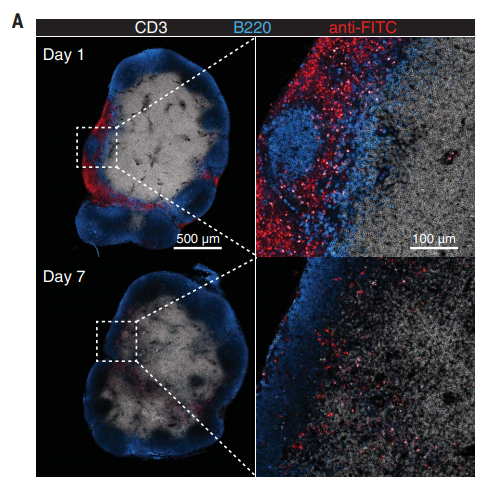
In addition to CAR-T cells, the mice's own immune cells (especially endogenous T cells) are also activated. CAR-T cells like the ones in the experiment specifically recognise the EGFRvIII protein on the surface of tumour cells, while other endogenous anti-tumour T cells can recognise additional tumour antigens, and together they can greatly enhance tumour clearance efficiency.
The authors found that without a vaccine to activate and expand their own anti-tumour T cells, tumours would still recur and grow even if CAR-T treatment cleared most of the cancer cells. In the test, even though only 80% of the cells in the tumours carried by the mice carried the CAR-T-targeted EGFRvIII antigen, the level of CAR-T interferon-gamma production was further enhanced genetically stimulated by the vaccine, and ultimately complete tumour clearance was achieved in 80% of the individual mice.
![▲研究示意图(图片来源:参考资料[2])](https://n.sinaimg.cn/sinakd20230708s/392/w996h996/20230708/03f6-4108b0f2ace536583bed148c2615bfe5.jpg)
The study notes that the percentage of cancer cells expressing specific antigenic targets may be as high as 90% in some solid tumours, meaning that the combination of vaccine plus CAR-T therapy is expected to break through the solid tumour barrier and bring hope for a cure to more cancer patients.
Reference:
[1] Vaccine delivers a boost to T cell therapy. Retrieved July 5, 2023 from https://www.eurekalert.org/news-releases/994304
[2] L.Y. Ma et al., Vaccine-boosted CAR T crosstalk with host immunity to reject tumors with antigen heterogeneity. Cell (2023). DOI: 10.1016/j.cell.2023.06.002
Source: Sina Finance

Latest News

Promoting Integration with Competitions and Showing Style
The first badminton match of "Kangrun Cup" was successfully held.
Building Elites with Aggressiveness and Winning the Future with Concentration and Effort
Jiangsu Kangrun Biotechnology Co., Ltd. 2023 New Employee Expansion Activities Successfully Conducted
Pre season talk about influenza vaccines: correct cognition without hesitation
Luwang, September 11th (Reporter Guan Xiaohui, Correspondent Li Chengxiu, Ma Jin) Influenza is an acute respiratory infectious disease caused by the influenza virus that poses a threat to human health. It is seasonal (commonly known as the "flu season") and can cause serious complications such as pneumonia, encephalitis, and even death in infants, young children, and the elderly. Therefore, outbreaks of COVID-19 are prone to occur in schools, kindergartens, and elderly care institutions. Although there was a nationwide outbreak of H1N1 influenza A from February to April this year, according to perennial epidemiological data in China, the southern and northern regions generally have a high incidence in winter and spring (November to February of the following year), and the areas south of the Yangtze River can also have a high incidence in summer. Therefore, we are currently in the pre flu season, which is the best time to receive influenza vaccines, especially for infants, young children, primary and secondary school students, the elderly, medical personnel, and entry-exit port staff. However, due to cognitive differences, some parents and vaccination populations have varying degrees of hesitation in vaccination, mostly suspecting the effective protection of the vaccine, followed by anxiety about vaccination safety. For this, let's talk about topics related to influenza vaccines together.


